Author
Juhi Dubey
E-Invoicing Strategic Readiness: Aligning Your Enterprise for the UAE’s New E-Invoicing Era
Pre-Webinar Insight Blog
The UAE is entering a new phase of digital tax transformation.
E-Invoicing in UAE is no longer a future concept; it is rapidly becoming a strategic priority for enterprises operating across the region. As the Federal Tax Authority (FTA) moves toward structured digital invoicing frameworks aligned with global best practices, organizations must shift their mindset from compliance preparation to enterprise readiness.
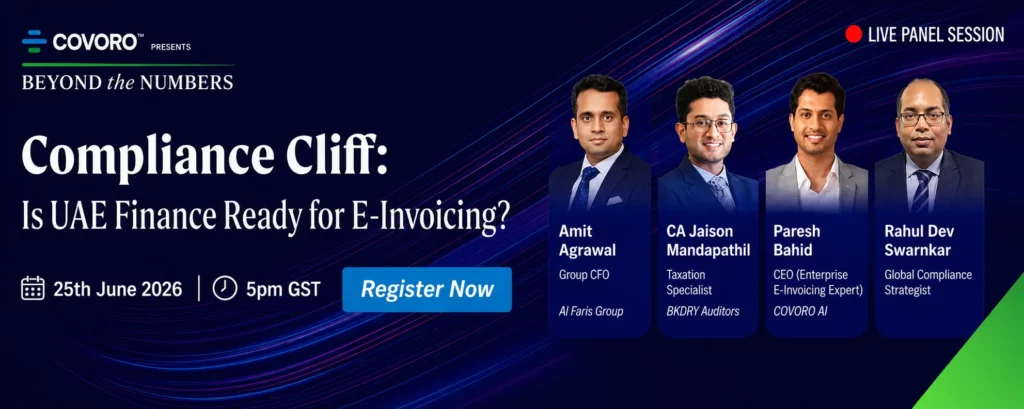
This upcoming webinar, “E-Invoicing Strategic Readiness: Aligning Your Enterprise for UAE’s New Era,” is designed to help business leaders understand not just what is changing, but how to prepare strategically.
Before we meet live, here are the key themes shaping the conversation.
1. E-Invoicing Is Not Just a Tax Change, It’s an Enterprise Transformation
Many companies see e-Invoicing mostly as something to do with finance or tax at first, but the effects are so much more than just following the rules. Being able to send electronic invoices affects...
When an enterprise implements e-Invoicing, it needs to be cross-functional, and not just one department doing a project by themselves.
Using e-Invoicing only as compliance can lead to operational backlogs, fragmented processes and ultimately long-term failure.
2. Why Strategic Readiness Matters Now
A clear trend across global markets is that when a country adopts e-Invoicing, it frequently progresses from voluntary adoption to mandatory implementation shortly thereafter.
By preparing for the changes brought on by e-Invoicing early, enterprises will:
Being strategically prepared means developing systems that can adapt to change, rather than simply responding to timelines/deadlines.
3. The Hidden Enterprise Risks of Delayed Preparation
Organizations that do not account for e-Invoicing can run into several challenges late on in the process, such as:
These are not technology problems alone; they are process and governance challenges.
The sooner enterprises conduct readiness assessments, the smoother the transition becomes.
4. The Shift from Manual Processes to Intelligent Automation
The UAE’s e-Invoicing direction signals a broader movement toward real-time digital tax ecosystems.
Forward-thinking organizations are already exploring:
Instead of viewing e-Invoicing as an obligation, leading enterprises see it as an opportunity to modernize finance operations.
5. Alignment Between Business, Technology, and Compliance
Three Pillars for Successful Implementation:
When any of the three pillars are not working together, organizations will experience delays, increased costs of implementation & resistance to adoption of the technology.
6. What Enterprise Leaders Should Be Asking Today
Before implementing a new solution, organizations should take stock of:
Answering these questions will help you decide whether you are reacting or being strategic in your approach.
7. What This Webinar Will Cover
In this session, we will explore:
The goal is simple: help organizations move from uncertainty to clarity, and from compliance pressure to strategic advantage.
8. Final Thought: The Opportunity Beyond Compliance
Every major digital tax transformation creates two types of organizations:
E-Invoicing in the UAE is more than a regulatory shift; it is an opportunity to rethink how finance operates, how data flows, and how enterprises scale confidently in a digital economy.
The question is no longer if change is coming, but how prepared your organization will be when it arrives.Join the Webinar
If your organization is navigating ERP readiness, compliance strategy, or digital finance transformation, this session is designed for you.
Register now and align your enterprise for the UAE’s new e-Invoicing era.
10. From Revenue-Ready to Clearance-Ready
Many aviation invoices are revenue-ready — acceptable to customers.
Few are compliance-ready — defensible to regulators.
COVORO ensures clearance readiness by validating:
Through advanced invoice processing software for aviation UAE, billing transitions from reactive reconciliation to proactive compliance control.
12. Why Aviation Leaders Choose COVORO
COVORO brings:
Aviation billing systems are operational engines.
COVORO ensures they become compliance engines as well.
As part of the world’s only ecosystem built for the CFO’s Office, COVORO connects:
Into a unified architecture aligned with UAE requirements.
13. Final Perspective: Aviation Billing Is Systems Engineering
UAE e-Invoicing does not require aviation businesses to simplify operations.
It requires them to formalize operational logic into deterministic billing rules.
When charge codes, rate tables, event mapping, and VAT logic are governed by structured systems:
Invoices become predictable.Audits become reconstructable.Compliance becomes embedded.
Through scalable digital invoicing for aviation companies in the UAE, COVORO transforms aviation billing from high-risk reconciliation to clearance-ready confidence.
In the era of structured reporting and regulatory transparency, aviation compliance is no longer a back-office function.
It is a systems discipline — and COVORO is built to lead it.
Acknowledgments
Every insight in this guide has been shaped with purpose — designed to be as engaging as it is informative.
Contributor
Saurabh Ujjainwal
Saurabh Ujjainwal contributed to the editorial framing, maintaining consistency, tone, and structure. His thoughtful input helped bring clarity and direction to the final version.
Design & Visuals
Sampada Kalhapure
Sampada Kalhapure gave abstract ideas a visual voice—turning trust, observability, and hybrid dexterity into graphics that simplify complexity and make the blog visually engaging.
Web & Digital Experience
Rahul Ingle
Rahul transformed the draft into a smooth digital experience, ensuring the blog reads effortlessly across platforms and reaches readers with the same polish as its ideas.
Juhi Dubey
About the Author
I am a semi-qualified CA with 4 years of experience in Accounts and finance. With a background in law and a passion for tax compliance, I have been deeply engaged in the Fin-Tech industry, composing insightful content. I am fond of writing and have contributed articles on accounting, personal finance, income tax, and GST.