
Regulatory Update
E-Invoicing Non-Compliance | A Detailed Guide for the UAE
Did you know that by July 2026, all value-added tax-registered companies in the UAE are required to meet the UAE Federal Tax Authority's (FTA) e-invoicing requirements? Before you imagine piles of fines and irate accountants, know there's a particular way to avoid e-invoicing non-compliance!
As the deadline approaches, UAE e-invoicing non-compliance might mean disaster, with huge fines looming for companies that need to check the correct boxes. The FTA has been very specific in its requirements, and coming up short will mean paying hefty fines that no business wants to encounter.
The move to e-invoicing is not simply a tax authority power play—it's intended to dismantle value-added tax fraud, introduce transparency into the mix, and make compliance a little less cumbersome (yes, really!). E-invoicing is meant to establish a more equitable, streamlined system that works for businesses and tax authorities alike.
This guide deals with the dos and don'ts of e-invoicing non-compliance, dissecting possible fines, types of violations, and practical actions to ensure your business remains on the good side of the FTA. Implementing e-invoicing sidesteps e-invoicing non-compliance pitfalls and reaps long-term advantages that prepare your business for a stress-free, easy future.
01
What Are the Operational Impacts of E-Invoicing Non-Compliance?
Failure to comply with e-invoicing laws in the UAE may attract substantial fines; hence, the need for businesses in the Gulf Cooperation Council to focus on compliance. Engaging the services of an Accredited Service Provider ensures that e-invoicing operations are up to the required standards by the Federal Tax Authority (FTA).
By creating fully FTA tax-compliant invoices, companies will be able to save on penalties while optimizing VAT compliance processes. Adopting the e-invoicing solution from an early point offers a window of opportunity for improving business functioning and ensuring trouble-free business procedures in the market.
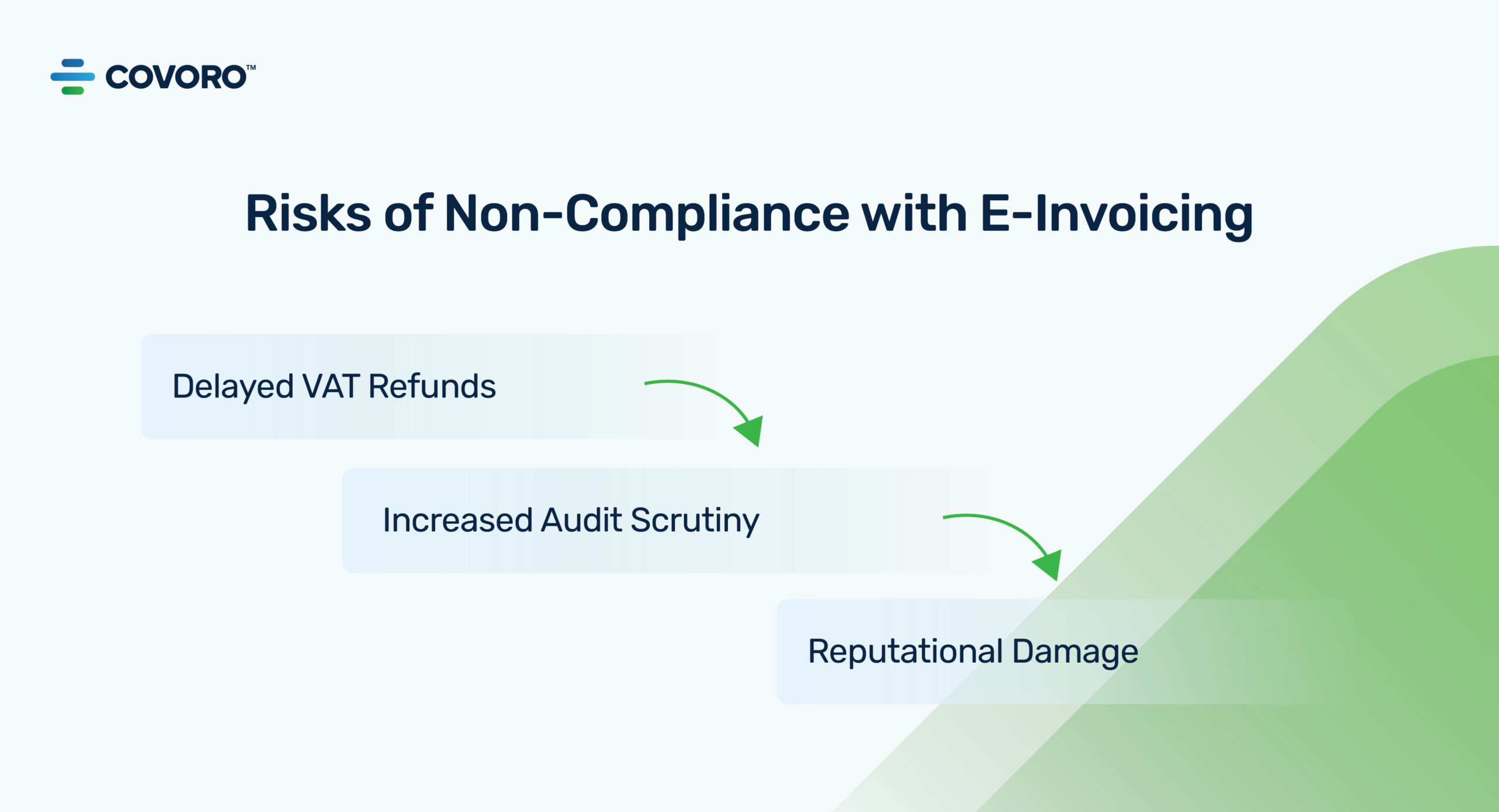
The Following Are the Risks of Non-Compliance with E-Invoicing
-
Delayed VAT Refunds: We need real-time e-invoicing submissions to ensure VAT refunds, creating cash flow challenges for businesses with extensive value-added tax credits.
-
Increased Audit Scrutiny: Businesses that fail to meet e-invoicing standards are more likely to be audited, leading to operational disruption and reputational damage.
-
Reputational Damage: Persistent non-compliance could tarnish a company's reputation, especially with partners, clients, and investors who value transparency and compliance.
-
Penalty for Non-Generation of E-Invoice Section: As per UAE VAT law, non-generation or late issuance of an e-invoice can result in penalties outlined under the penalty for non generation of e invoice section, which can escalate based on repeated offenses.
02
E-Invoicing Non-Compliance Penalties: Recent Updates
The FTA has introduced amendments to UAE VAT penalties in preparation for mandatory Electronic invoicing by July 2026. From June 2024, businesses that fail to comply with VAT laws can reduce their penalties by up to 30%, provided they meet specific conditions.
With the e-invoicing deadline approaching, the FTA is pushing for compliance more than ever. Non-compliance could lead to severe financial issues, such as e invoicing penalties, reputational damage, and operational disruptions, making it essential for businesses to act promptly.
03
How Does E-Invoicing Benefit Businesses in the Long Run?
While compliance with e-invoicing is mandatory, the advantages of adopting e-invoicing go beyond the purpose of e-invoicing, such as ensuring accurate VAT reporting and avoiding UAE VAT penalties. Early adoption can lead to:
-
Cost Savings: Automation reduces manual errors and the costs of paper-based invoicing.
-
Operational Efficiency: Real-time submissions streamline tax reporting, reducing administrative burdens and allowing businesses to focus on growth.
-
Improved Cash Flow: Faster value-added tax refunds due to accurate, real-time reporting enhance cash flow predictability.
-
Better Business Intelligence: Digitized invoicing enables businesses to gather real-time data insights, allowing for more informed decision-making.
04
What Are the Best Practices to Avoid E-Invoicing Penalties?
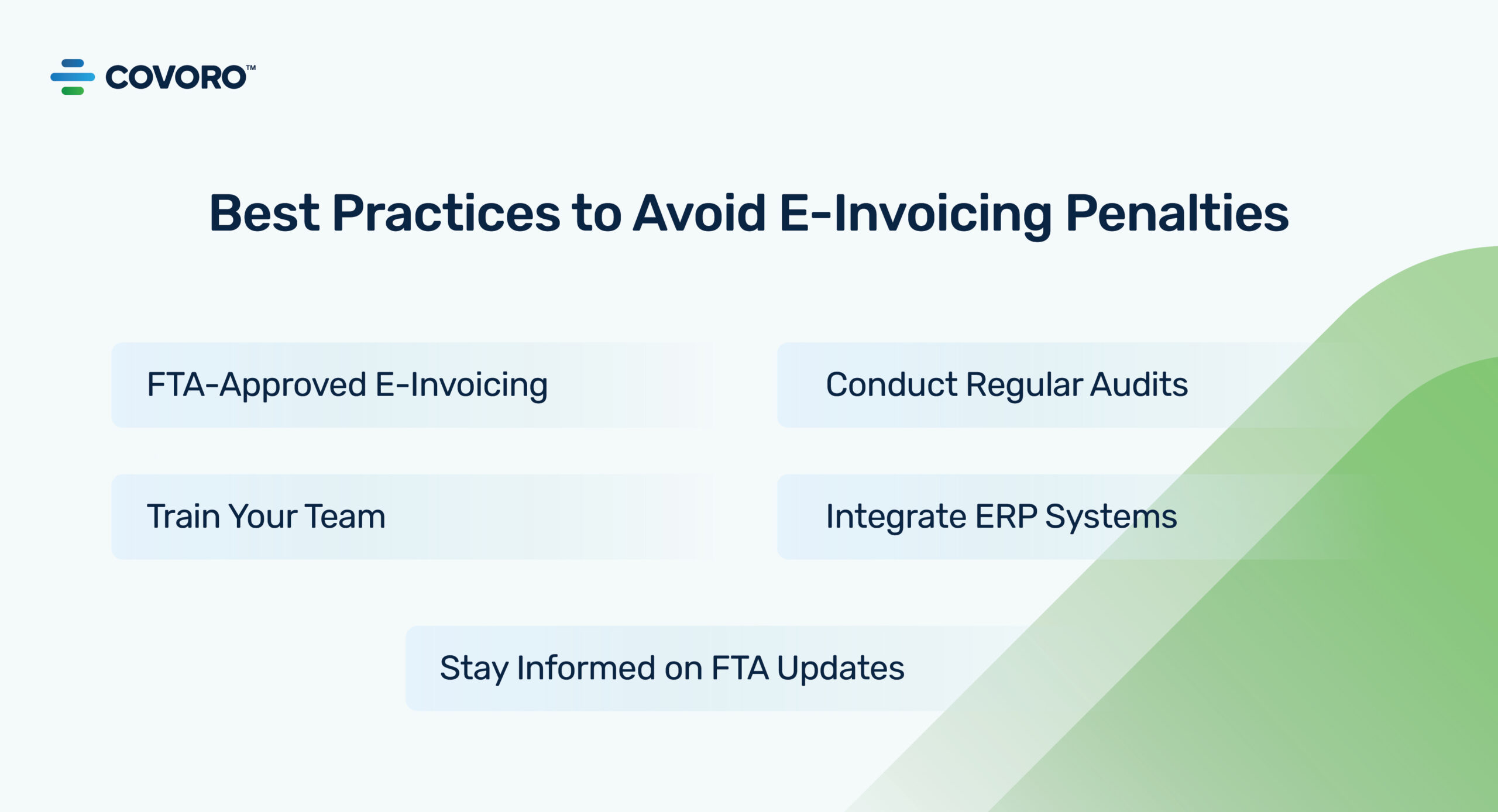
Businesses should take these proactive steps to ensure compliance and avoid E-invoicing penalties.
- Implement FTA-Approved E-Invoicing Solutions: Ensure your business uses software accredited by the FTA and compliant with Peppol FTA standards and Peppol Access Points. Early adoption allows you to iron out any technical issues.
- Train Your Team: Ensure all finance and tax-related staff are trained on the e-invoicing regulations and know how to use the software effectively.
- Conduct Regular Audits: Periodic audits of your e-invoicing system can help identify any non-compliance issues before they result in fines.
- Integrate ERP Systems: Seamless integration between your e-invoicing solution and ERP/accounting systems ensures you minimize errors and automate VAT penalties.
- Stay Informed on FTA Updates: Keep up with any changes or updates from the FTA regarding compliance guidelines and technical requirements.
05
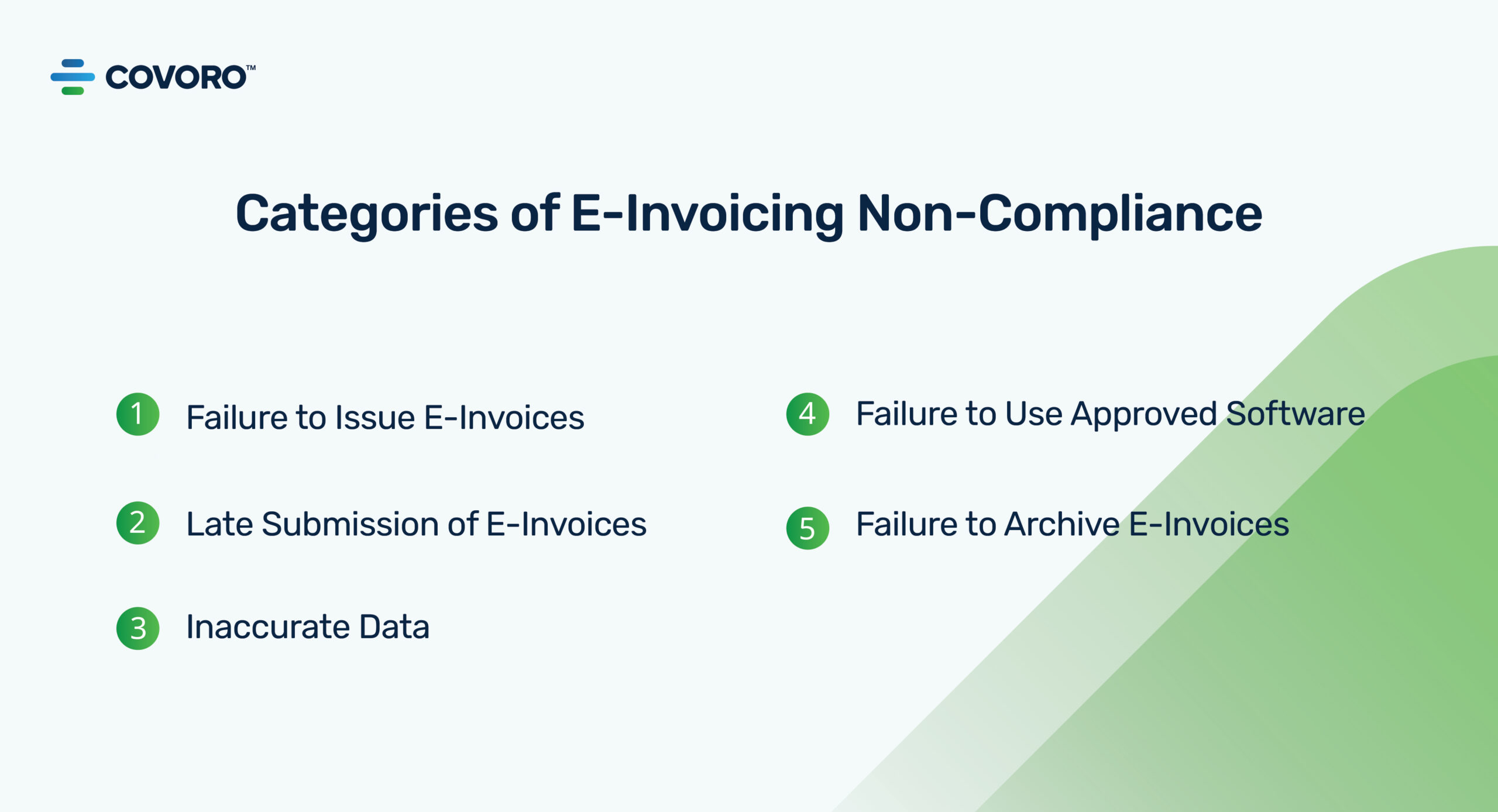
Categories of E-Invoicing Non-Compliance and Penalties
|
Category of Non-Compliance |
Penalty |
|---|---|
|
Failure to Issue E-Invoices |
AED 5,000 for the first offense; up to AED 20,000 for repeated offenses |
|
Late or Incomplete Submission of E-Invoices |
Starting from AED 3,000; up to AED 10,000 for repeated delays |
|
Inaccurate Data or Missing Information |
AED 2,000 to AED 15,000 depending on severity and frequency |
|
Failure to Use FTA-Approved Software |
Starting from AED 3,000; increasing for continuous non-compliance |
|
Failure to Archive E-Invoices |
Starting from AED 5,000; higher penalties for repeated violations |
06
What Should Businesses Expect Going Forward with E-Invoicing?
The 2026 e-invoicing deadline is approaching quickly, and businesses must act now to avoid last-minute issues. The FTA has provided pilot programs, clear guidelines, and approved software to help transition.
Delaying could lead to penalties, audits, and operational problems. Starting early with a solid compliance plan will ensure your business is ready for 2026 and beyond.
07
Simplify Tax Compliance with Covoro: Your Partner for E-Invoicing and GST Solutions
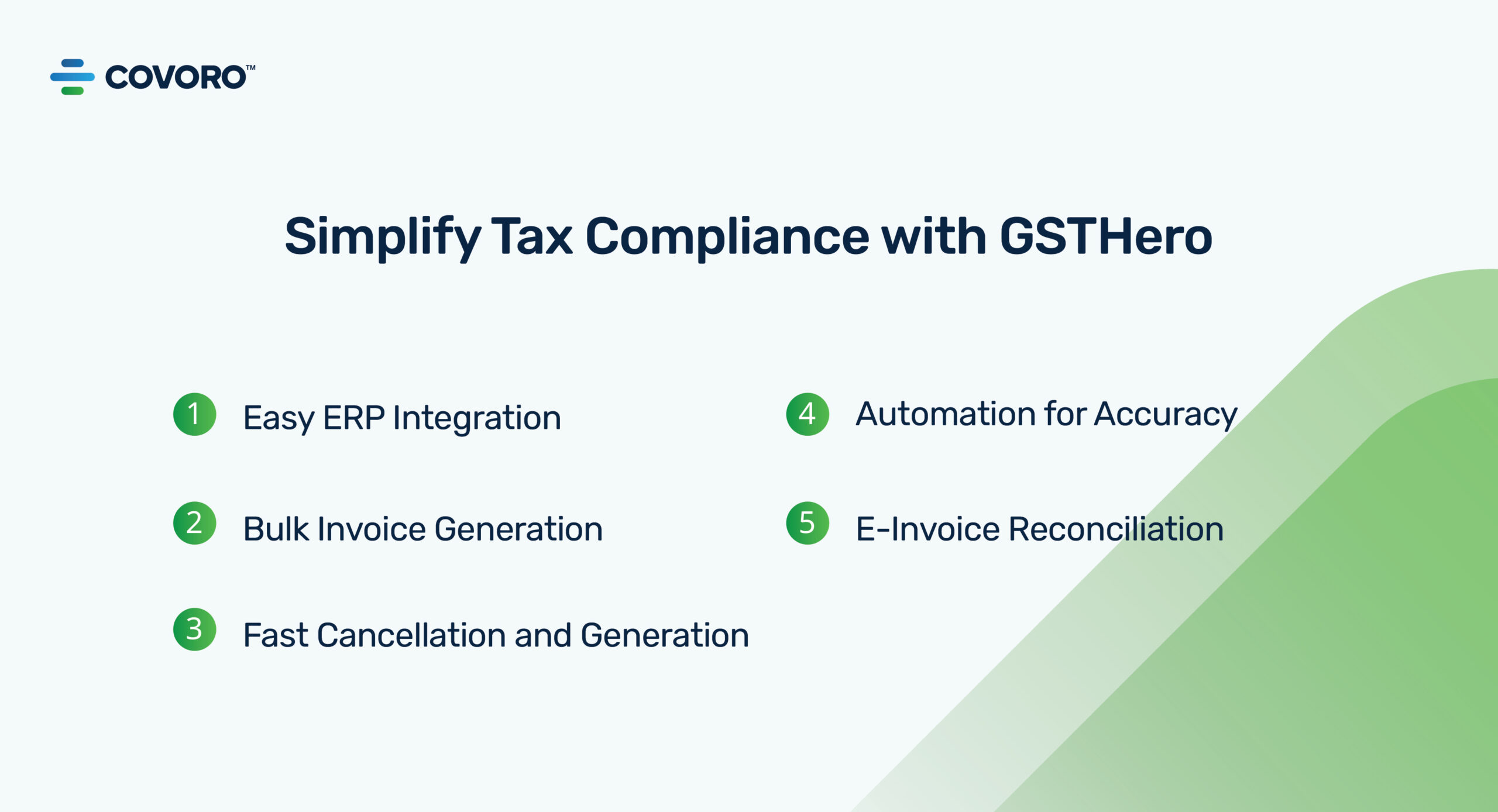
COVORO is the ultimate solution for e-invoicing compliance in the UAE, designed to simplify operations while ensuring 100% FTA compliance with UAE Federal Tax Authority (FTA) guidelines. With the capacity to manage 135 million invoices annually and process 8 million records in just 40 minutes, GST Hero delivers unmatched speed and efficiency.
Key Features and Benefits:
- Easy ERP Integration: Seamlessly connects with leading ERPs like SAP, Tally, Oracle, and Microsoft for faster compliance with Peppol FTA standards.
- Bulk Invoice Generation: This handles large volumes of invoices effortlessly, saving time and effort for businesses of all sizes.
- Automation for Accuracy: Eliminates manual errors and improves operational efficiency, ensuring compliance with UAE FTA guidelines.
- Fast Cancellation and Generation: Enables rapid creation and cancellation of e-invoices with a single click using Peppol Access Points for smooth transactions.
- Certified Support: Offers expert assistance to overcome technical challenges and ensure seamless adherence to compliance standards.
COVORO automation tools enhance accuracy and speed and leverage Peppol Access Points to enable secure, standardized communication between businesses and the UAE FTA.
With dedicated support and robust features, COVORO helps companies meet compliance requirements, avoid penalties, and unlock greater operational efficiency and reliability in the UAE.
08
Conclusion
E-invoicing represents a significant shift in tax compliance in the UAE, and businesses that fail to comply will face substantial penalties and operational risks. You can avoid these costly consequences while improving your business's operational efficiency by implementing e-invoicing in the UAE, FTA-approved systems, conducting regular audits, and training your staff.
Compliance is not just about avoiding fines—it's about positioning your business for long-term success in a transparent and efficient tax environment.
09
FAQ
What is the deadline for e-invoicing compliance in the UAE?
The UAE has set July 2026 as the mandatory deadline for all VAT-registered businesses to comply with e-invoicing regulations. Companies must ensure they are prepared to meet these requirements to avoid non-compliance penalties.
What are the penalties for failing to issue e-invoices?
Failing to issue e-invoices can result in fines starting at AED 5,000 for the first violation. For repeated offenses, the penalties can increase up to AED 20,000, underscoring the importance of consistent compliance.
What happens if I submit e-invoices late?
Late submissions of e-invoices can lead to fines starting at AED 3,000. For businesses that continue to delay submissions, the penalties can rise to AED 10,000, making timely compliance crucial.
Do I need FTA-approved software for e-invoicing?
Yes, businesses must use software approved by the UAE Federal Tax Authority (FTA) that complies with Peppol FTA standards. This ensures that e-invoices meet the technical and legal requirements set by the UAE authorities.
What are the consequences of not archiving e-invoices?
Failure to properly archive e-invoices as per FTA requirements can result in fines starting at AED 3,000. Repeated violations may attract higher penalties, emphasizing the need for proper record-keeping practices.
Will non-compliance affect my VAT refunds?
Yes, non-compliance can lead to delays in VAT refunds. This can disrupt cash flow, particularly for businesses with significant VAT credits, making compliance essential for financial stability.
How can I avoid penalties for non-compliance?
Businesses should implement FTA-approved e-invoicing software to meet technical requirements. Training staff on its proper use, conducting regular compliance audits, and staying updated with the latest FTA guidelines are also essential to avoid fines and ensure smooth operations.
When is E-Invoicing Mandatory?
E-invoicing becomes mandatory in the UAE by July 2026 for all VAT-registered businesses. Compliance with e-invoicing regulations is essential to avoid fines and streamline VAT reporting processes.
Can I reduce penalties for past VAT non-compliance?
Yes, businesses can reduce penalties by up to 30% if they rectify past errors and meet specific conditions by June 2024. This provides an opportunity to minimize financial risks before the e-invoicing mandate becomes mandatory.
What is Invoice Compliance?
Invoice compliance refers to adhering to the legal and regulatory requirements set by the Federal Tax Authority (FTA) for issuing and managing tax invoices. This includes generating accurate, FTA-compliant tax invoices using approved formats, ensuring proper record-keeping and credit notes, and following all guidelines to avoid penalties.
What are the consequences of non compliance with e-invoicing?
Failure to properly archive e-invoices as per FTA requirements can result in fines starting at AED 3,000. Repeated violations may attract higher penalties, emphasizing the need for proper record-keeping practices.
What is the penalty for incorrect invoicing under GST?
Incorrect invoicing under the GST framework (similar to UAE VAT) can result in significant penalties, with fines varying based on the nature of the discrepancy and applicable under the penalty for non generation of e invoice section.
Categories
Table of Contents
08
09
About the Author

Juhi Dubey
I am a semi-qualified CA with 4 years of experience in Accounts and finance. With a background in law and a passion for tax compliance, I have been deeply engaged in the Fin-Tech industry, composing insightful content. I am fond of writing and have contributed articles on accounting, personal finance, income tax, and GST.
Found this useful?
Share it with a click.
Agentic AI-Powered Compliance
Ready for UAE E-Invoicing? We are.
Explore how COVORO helps CFOs lead — not just comply.
You might also like