Regulatory Update
Beyond Compliance: Why Oman CFOs Should Embrace E-Invoicing as a Strategic Opportunity

Ask most finance teams what e-Invoicing is for, and you'll get the same answer: it's what the regulator wants. A box to tick before a deadline. That answer isn't wrong, but it's incomplete, and it's costing organizations a much bigger opportunity than the one sitting right in front of them.
Around the world, the businesses getting the most out of digital invoicing aren't the ones that went live fastest. They're the ones that used the mandate as an excuse to fix things that were broken long before regulation forced the issue, fragmented processes, inconsistent data, manual approvals nobody trusted. As Oman moves further into its digital transformation agenda, its CFOs have a choice: implement e-Invoicing as instructed, or use it as the opening move in a much bigger game.
It's exactly this shift, from regulatory checkbox to strategic lever, that COVORO's next Beyond the Numbers panel is built around. Beyond Compliance: How Oman CFOs Can Turn e-Invoicing into a Strategic Advantage brings finance, audit, and technology leaders together on 6 August 2026 to unpack what that looks like in practice. More on how to join is below; first, here's the thinking behind it.
01
The CFO's Job Has Already Moved On
Financial reporting and budgeting used to be the whole job. They're not anymore. Finance leaders are now expected to sit at the center of digital transformation, setting the pace for automation, shaping how the business makes decisions, and making sure technology investments actually pay off.
That shift changes what e-Invoicing is. It stops being an IT rollout with a tax deadline attached and becomes something finance owns outright, with real consequences for governance, data quality, supplier relationships, and how the whole organization performs. A CFO who treats it that way isn't just staying compliant. They're building the next phase of the finance function.
02
Compliance Gets You in the Door. It's Not the Whole Story.
E-invoicing in Oman isn't happening in isolation; it's part of a broader regional and national shift toward digital tax administration. The key drivers include:
- Tighten financial controls by standardizing invoice workflows and cutting out manual handling
- Give finance real-time visibility into transaction data, instead of end-of-month reconstruction
- Speed up approvals and improve cash flow, since invoices no longer sit waiting on someone's desk
- Strengthen supplier relationships by removing the friction and delay that erode trust over time
- Compliance is where the project starts. Operational excellence is where it should end up.
03
The Real Deliverable Is Better Data
Every serious digital finance initiative- AI, automation, forecasting, compliance monitoring, all of it- depends on one thing first: data you can actually trust. Not data that's roughly right after someone cleans it up in Excel, but data that's structured and consistent by design.
That's what e-Invoicing quietly builds. It forces standardized, machine-readable financial information across the organization, which becomes a single source of truth finance teams can automate against, report from, and make faster decisions with. Most organizations don't realize they're building this foundation until they're ready to use it.
04
Where AI Actually Fits, And Where It Doesn't
AI gets talked about as the starting point for finance transformation. It rarely is. AI is only as good as the data and processes feeding it, and most organizations attempting AI initiatives are trying to build on ground that isn't solid yet.
Once invoice data is standardized and workflows are automated, the next layer becomes realistic: automated validation, exception handling, fraud detection, predictive analytics, real-time insight into financial performance. The CFOs getting ahead aren't treating e-Invoicing and AI as two separate projects competing for budget. They're treating them as one continuous roadmap.
05
Where Implementations Actually Go Wrong
Software is rarely the reason e-Invoicing projects stall. The real obstacles tend to be more human:
-
- Finance, IT, procurement, and operations pulling in different directions with no shared owner
- Processes that were inconsistent long before the mandate, now just inconsistent and digital
- Resistance to change that no system rollout, by itself, can fix
- An assumption that "compliant" equals "done" with no roadmap for what comes after
Without clear executive sponsorship and ownership, the business case for anything beyond the bare minimum quietly disappears. Naming these risks early is usually the difference between a project that meets a deadline and one that actually changes how finance operates.
06
Five Questions Oman CFOs Should Be Asking Right Now
The wrong question is "how fast can we get compliant?" The more useful ones are harder and more valuable:
- How does e-Invoicing fit into our broader finance transformation goals?
- Are our processes standardized enough to support real automation?
- Do Finance, IT, and Operations actually share a governance model, or just a deadline?
- What could structured financial data do for our decision-making that we're not doing today?
- Are we building capabilities that hold up as regulation and technology keep moving?
- How an organization answers these will shape more than its compliance timeline. It will shape how competitive its finance function is three years from now.
07
The Bottom Line
For Oman, e-Invoicing was never really about the invoice. It's an early signal of a much bigger shift toward finance that's connected, data-led, and ready for what automation and AI make possible next.
The organizations that win here won't be the ones that go live first. They'll be the ones that went live with a plan for what comes after, using this moment to modernize finance, tighten governance, and build a function that treats compliance as a floor, not a ceiling.
08
Join the Conversation: Beyond Compliance
COVORO is bringing these exact questions to Oman's finance leaders in the next session of the Beyond the Numbers panel series:
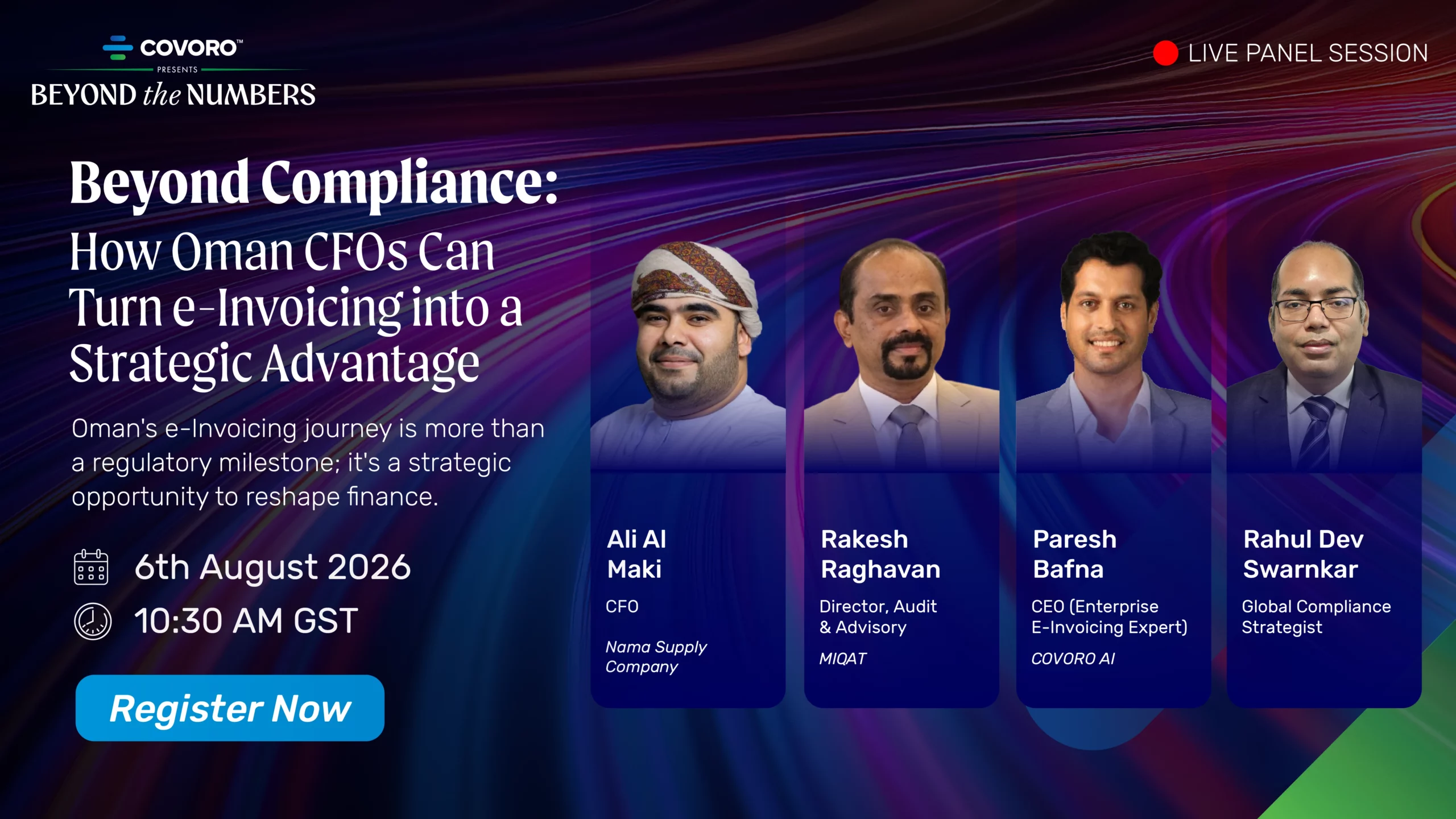
Together, they'll unpack the CFO's role in Oman's digital tax transformation, how to turn compliance into measurable business value, and what it takes to get finance ready for AI, automation, and the regulatory change still ahead. Expect practical, on-the-ground perspectives, not theory.
Categories
Table of Contents
About the Author

Juhi Dubey
I am a semi-qualified CA with 4 years of experience in Accounts and finance. With a background in law and a passion for tax compliance, I have been deeply engaged in the Fin-Tech industry, composing insightful content. I am fond of writing and have contributed articles on accounting, personal finance, income tax, and GST.
Found this useful?
Share it with a click.
Agentic AI-Powered Compliance
Ready for Oman E-Invoicing? We are.
Explore how COVORO helps CFOs lead — not just comply.
You might also like